
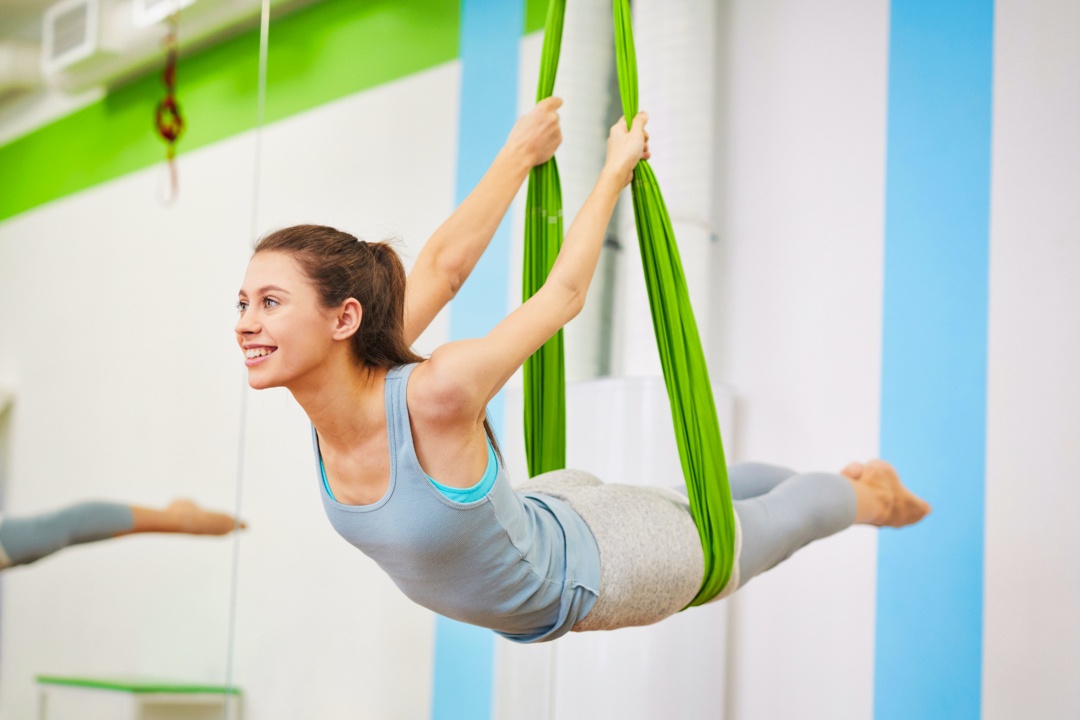

Rehabilitation in Singapore has traditionally been the domain of physiotherapy clinics, hospital outpatient departments, and sports medicine practitioners. But over the past several years, a different kind of recovery space has been quietly earning its place alongside these established options: the aerial yoga studio. Suspended hammocks, careful sequencing, and the principles of passive traction have made aerial yoga a compelling adjunct tool for post-injury recovery, neurological rehabilitation, and chronic pain management. As more yoga places in Singapore expand their aerial offerings, it is worth examining exactly why this practice is crossing over from fitness into rehabilitation territory.
The Mechanical Principles Behind Aerial Yoga’s Rehabilitative Value
Aerial yoga uses a fabric hammock suspended from the ceiling at an adjustable height. Practitioners use this hammock for support, suspension, and resistance across a wide range of movements. Unlike mat yoga, the hammock removes full or partial bodyweight from the equation, which changes the entire mechanical context of movement.
This is the core of its rehabilitative appeal. Many post-injury or chronic pain presentations involve tissues (joints, muscles, discs) that cannot tolerate full weight-bearing or compression during the recovery phase. The aerial hammock creates an environment where:
- Spinal vertebrae decompress under the effects of partial or full inversion
- Joint surfaces are unloaded, allowing movement without compressive pain
- Neuromuscular re-patterning can occur without the body defaulting to its habitual protective guarding responses
- Range of motion can be explored gradually, with the hammock providing resistance or assistance as needed
These are not incidental benefits. They reflect genuine biomechanical principles that physiotherapists use in hydrotherapy and suspension therapy, both of which operate on similar logic.
Spinal Rehabilitation: Where Aerial Yoga Has the Most Clinical Relevance
The majority of Singaporeans who find their way to aerial yoga for rehabilitative purposes do so because of spinal complaints. This is unsurprising given Singapore’s population demographics and work culture.
Post-Disc Injury Recovery
After a disc herniation or disc bulge, the goal of rehabilitation is to reduce nerve compression and restore function without re-injuring the vulnerable tissue. Inversion-based decompression in the aerial hammock can reduce intradiscal pressure in the lumbar spine, creating a temporary reduction in the forces compressing the affected disc against surrounding nerve tissue.
This decompression is not curative, but it can significantly reduce pain levels during the recovery phase, allowing practitioners to engage in rehabilitative movement that would otherwise be too painful on a mat or in standing positions. Over time, as the disc heals and surrounding muscles are retrained to support proper spinal mechanics, the aerial work becomes less about pain management and more about functional restoration.
Post-Surgical Spinal Recovery
Several physiotherapists in Singapore have begun referring post-surgical patients (particularly those recovering from spinal fusion procedures) to aerial yoga as a complementary activity during the later stages of rehabilitation. The hammock allows graduated loading of the spine in positions of extension and rotation that would be difficult to manage safely on a mat without the risk of compensation from surrounding muscle groups.
This referral pattern is still emerging rather than formalised, but it reflects growing recognition among musculoskeletal practitioners that movement environments beyond the clinical setting have genuine value in recovery.
Joint Rehabilitation and Aerial Yoga
Beyond spinal applications, aerial yoga has specific utility in the rehabilitation of peripheral joints.
Shoulder Rehabilitation
The shoulder is the most mobile and most commonly injured joint in the human body. Post-injury or post-surgical shoulder rehabilitation requires graduated loading in multiple planes of motion. The aerial hammock allows practitioners to work the shoulder through rotational and abduction movements with the arm partially supported, reducing the load on the healing rotator cuff muscles while still training the neuromuscular patterns needed for full functional recovery.
Crucially, the hammock provides proprioceptive feedback (information about joint position) that helps retrain the shoulder’s stabilising muscles to fire in the correct sequence. Loss of this proprioceptive accuracy is one of the primary reasons shoulders re-injure after an initial trauma.
Hip and Knee Joint Unloading
For individuals recovering from hip arthritis management, knee ligament rehabilitation, or post-knee replacement recovery, aerial yoga allows lower limb movement with significantly reduced joint compression. This is particularly useful in the gap between what clinical physiotherapy addresses and what the person can safely do in a standard exercise class.
Hip openers performed in the hammock, for example, allow the hip joint to move through a wider range of motion with less groin compression than floor-based poses, making them accessible to practitioners who would find the same movement painful without the support.
Neurological Applications: An Emerging Area
This is perhaps the most frontier aspect of aerial yoga’s rehabilitative potential, and it should be approached with appropriate caution. But it is worth discussing because several practitioners in Singapore’s rehabilitation community have noted benefits for specific neurological populations.
Proprioceptive Retraining After Neurological Events
Following a stroke, traumatic brain injury, or conditions affecting motor control, one of the rehabilitation challenges is retraining the nervous system to accurately sense and control body position. The aerial hammock provides constant tactile and proprioceptive feedback through the fabric’s contact with the body, which some neurologically-affected individuals find helps them maintain awareness of their body position in space during movement.
Vestibular Stimulation for Balance Disorders
The gentle swinging and instability of the aerial hammock provides vestibular stimulation (input to the inner ear’s balance system) that can be useful in rehabilitation of balance disorders. This is an area where collaboration between yoga instructors and vestibular physiotherapists would be most appropriate, and is not something to be undertaken without professional guidance.
What Makes Aerial Yoga Different From Physical Therapy
It is important to be clear that aerial yoga does not replace physiotherapy. The two serve different but complementary functions.
Physiotherapy provides:
- Diagnosis and clinical assessment of the specific injury or condition
- Targeted manual therapy, taping, and electrophysical modalities
- Graded exercise prescription based on clinical knowledge of tissue healing timescales
- Monitoring of objective outcome measures such as strength testing and range of motion measurement
Aerial yoga provides:
- A movement environment that supports the body while encouraging active participation
- Group practice that combats the social isolation often associated with chronic pain and lengthy rehabilitation
- Mindfulness and breathing practices that support pain management and nervous system regulation
- A bridge between clinical rehabilitation and return to full physical activity
The most effective rehabilitation outcomes come when both are used in an informed, coordinated manner.
Choosing the Right Studio for Rehabilitative Aerial Yoga
Not every aerial yoga class is appropriate for someone in a rehabilitation context. Knowing what to look for in a studio environment is critical.
Key factors to consider:
- Instructor qualifications, specifically whether the instructor has experience working with injury presentations or has undertaken any rehabilitation-focused training
- Class size, because smaller classes allow instructors to provide the individualised attention that rehabilitation contexts require
- The ability to modify sequences for individual limitations without disrupting the class
- Clear communication protocols between the studio, the practitioner, and any treating healthcare professionals
- The studio’s willingness to progress or regress your practice based on your recovery stage rather than a fixed class sequence
For those seeking aerial yoga as part of a rehabilitation approach, Yoga Edition provides structured aerial programmes with experienced instructors who are familiar with adapting practice to individual physical needs.
FAQ
Q: Do I need medical clearance before starting aerial yoga for rehabilitation?
A: Yes, particularly if you are recovering from a surgical procedure, managing an active disc injury, or dealing with any neurological condition. A letter from your physiotherapist or doctor outlining your current limitations and any movements to avoid is the most responsible starting point.
Q: Can aerial yoga worsen an existing injury?
A: Incorrectly performed aerial yoga, or aerial yoga that is not appropriately modified for your specific condition, can potentially aggravate certain injuries. This is why instructor experience and your own transparency about your injury history are both critical. Never attempt aerial inversions without guidance if you have a history of glaucoma, uncontrolled blood pressure, or recent spinal surgery.
Q: How is aerial yoga different from using a physiotherapy suspension system like a TRX?
A: TRX and similar systems primarily use suspension to challenge balance and increase the difficulty of strength exercises. The aerial yoga hammock is used for decompression, passive stretching, and supported movement exploration. The philosophical and mechanical approaches differ significantly, though both use suspension as their core principle.
Q: Are aerial yoga hammocks safe for heavier individuals?
A: Commercial aerial yoga hammocks used in certified studios are rated to support between 300 and 900 kilograms, far beyond any individual body weight. The structural anchors and ceiling mounts are subject to engineering load requirements. Body weight is not a limiting factor for aerial yoga participation.
Q: How frequently should I attend aerial yoga sessions if I am using it as part of rehabilitation?
A: Most rehabilitation contexts benefit from two sessions per week, which is frequent enough to build cumulative improvement without overloading tissues that are still in a healing phase. Your treating physiotherapist should be involved in this decision, as the optimal frequency depends on the specific condition and your overall rehabilitation load.

Comments are closed.